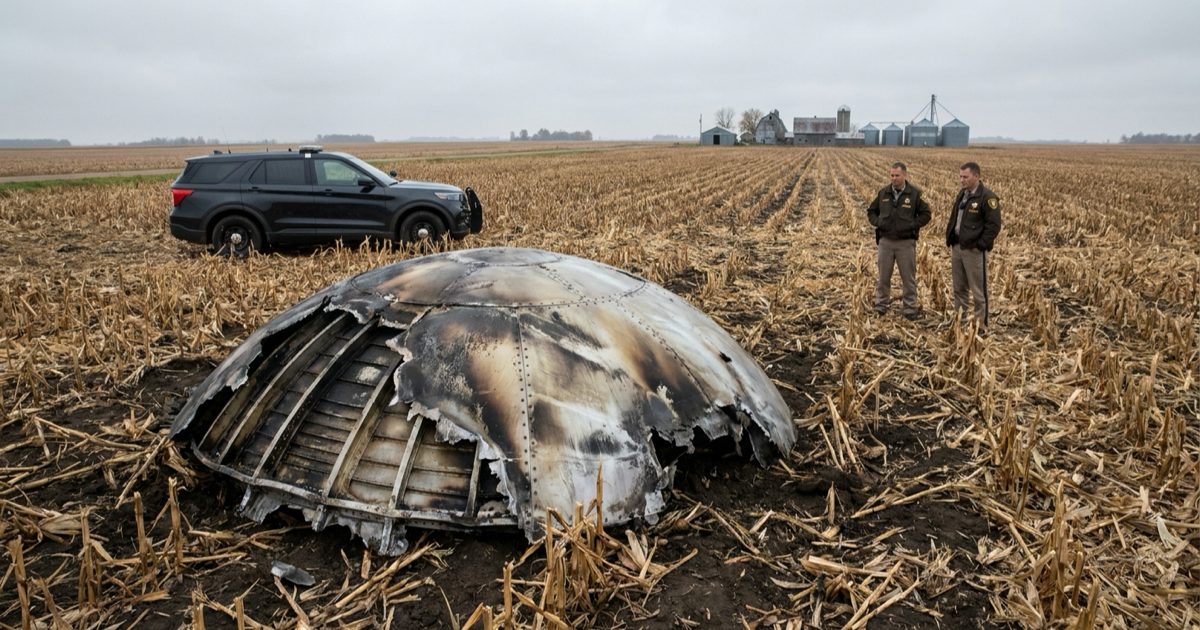
MORRIS, Minn. — A Stevens County, Minnesota, farmer found suspected rocket debris in his cornfield on the afternoon of Oct. 14, prompting a call to the Stevens County Sheriff’s Office. Deputies who responded to the field in Scott Township, southwest of Morris, found a dome-shaped, charred object roughly 11 feet across.
In an Oct. 15 statement, the Stevens County Sheriff’s Office called the item “a large, metallic object” that was “presumably a space object.” The office said state and federal agencies had been called in to identify it, locate its owner and arrange removal, and that it posed no danger to the public.
No farmer’s name has been released. Reached Oct. 20 by USA TODAY, Sheriff Jason Dingman said he expected to release more information the next day. Minnesota Public Radio reported this week, however, that the sheriff’s office would share no further details and pointed questions to the U.S. State Department.
A tentative identification, not an official one
The State Department offered only a narrow confirmation. A spokesperson told MPR News the item “has been secured and poses no danger to the public,” adding that the department “is working with interagency partners to determine the nature and origin of the debris.” That statement stopped short of naming a rocket, a country or a company.
The Zhuque-2E theory comes instead from outside space-tracking analysts. Ars Technica space reporter Stephen Clark reported that the diameter of the Minnesota object — 3.35 meters, or 11 feet — matches the upper stage of a Zhuque-2E rocket built by Chinese company LandSpace. That rocket launched Sept. 15 from a spaceport in northwest China, carrying 10 satellites for the Qianfan (“Thousand Sails”) broadband constellation, a Chinese counterpart to SpaceX’s Starlink network.
Clark’s reporting ties the rocket’s flight path — south over China and Antarctica, then north over the Americas — to where the object was found, and the timing to social media videos of fiery debris over the upper Midwest the night of the launch, including footage from Marshall, Minnesota. West Central Tribune and Gizmodo reached the same conclusion, both citing Ars Technica.
LandSpace has not publicly acknowledged that the debris belongs to its rocket. Deorbiting a spent upper stage is standard practice for limiting orbital clutter, and operators typically aim the burn so wreckage lands in the ocean. The Minnesota object’s landing on dry land, well off any ocean disposal corridor, suggests the deorbit burn may have gone wrong, Ars Technica reported.
Not the only piece to fall this month
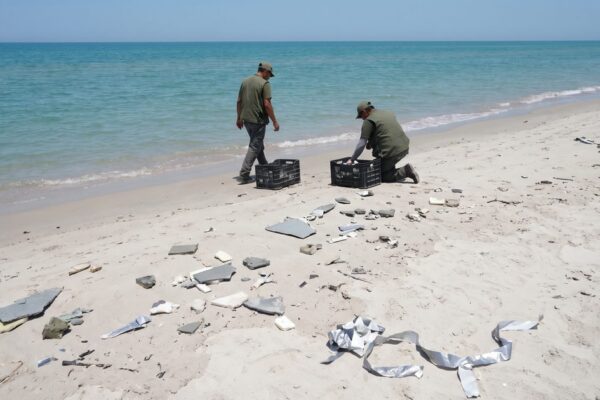
Within days of the Minnesota find, a separate suspected Zhuque-2E fragment — a car-sized aluminum plate about 30 feet wide — turned up in a palm oil plantation in Indonesia’s Central Kalimantan province, after residents reported hearing a loud bang overnight. Indonesia’s National Research and Innovation Agency said that debris also appeared to come from a Zhuque-2E launch, according to local outlet Kompas.id — this one lifting off Oct. 14, the same day the Minnesota object was discovered, on a separate mission.
Chinese rocket hardware has reached the ground in that region before: Long March 5B debris fell over Kalimantan and Sarawak, Malaysia, in August 2022, and damaged homes in two villages in Cote d’Ivoire in May 2020. Under international law, the launching country can be held liable for ground damage, though no such claim has ever been publicly pursued to compensation.
The episode adds to growing concern over debris that doesn’t stay in orbit. The FAA has withdrawn a proposed rule that would have required launch providers to deorbit rocket upper stages within 25 years, and the European Space Agency’s 2026 environment report found orbital debris risk worsening sharply. The Philippines has issued back-to-back warnings to ships and aircraft over falling Chinese rocket hardware in the past year. NASA’s Orbital Debris Program Office tracks reentry risk more broadly, though neither agency has commented on the Minnesota object.
What’s confirmed remains narrower than the headlines suggest: a metal object fell over Minnesota, roughly the size of a known Chinese rocket component, with no official account of its origin beyond that.
Subscribe to FODNews for continuing coverage of FOD incidents and prevention worldwide.
Sources
- MPR News — “Chinese rocket could be source of debris found in Minnesota field” (Oct. 22, 2026)
- USA TODAY — “Here’s everything we know so far about this mysterious ‘space object’ that crashed into a Minnesota farm” (Oct. 21, 2026)
- Ars Technica — “A Chinese rocket deorbited over Minnesota and left this in a farmer’s cornfield” (Oct. 20, 2026)
- Gizmodo — “A Minnesota Farmer Found an 11-Foot Metal Object in His Cornfield. It Came From Space” (Oct. 21, 2026)
- West Central Tribune — “Object from Minnesota cornfield possibly remnant of Chinese rocket” (Oct. 21, 2026)
- Stevens County Sheriff’s Office — Oct. 15, 2026 Facebook statement