Astroscale UK said Wednesday, Sept. 30, 2026, that it has achieved ISO/IEC 27001:2022 information-security certification, a milestone the British company says will underpin its upcoming ELSA-M debris removal mission to capture and de-orbit a dead satellite.
Astroscale UK, the British subsidiary of Japan’s Astroscale Holdings, said the certification followed an independent audit and a 20-month, company-wide effort to overhaul its security policies, processes and oversight. The company said its implementation also addresses newer risks tied to artificial intelligence and third-party suppliers.
“Our missions combine frontier robotics and autonomous rendezvous with exacting operational discipline,” Nick Shave, managing director of Astroscale UK, said in a statement.
The certification is a modest headline on its own. But Astroscale UK is pitching it as groundwork for two sensitive programs: ELSA-M, its commercial debris-removal demonstration, and Orpheus, a satellite-servicing effort for the UK Ministry of Defence. Consequently, the company says the security framework is meant to reassure government partners and suppliers handling data tied to both.
ELSA-M Debris Removal Faces Its First Test
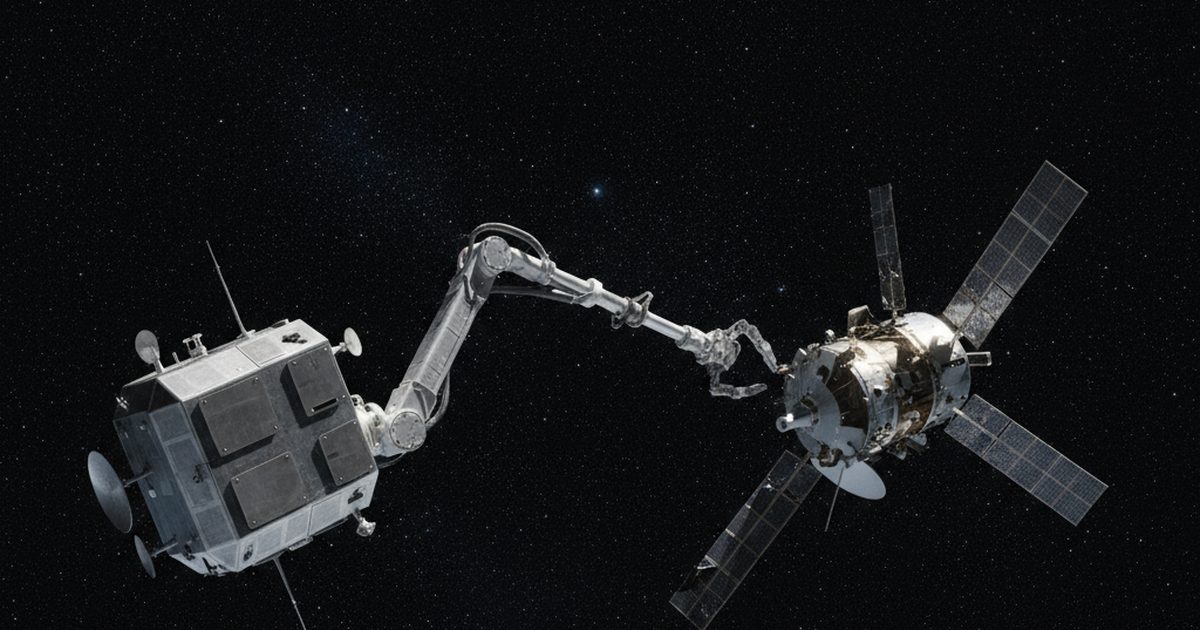
ELSA-M — short for End-of-Life Services by Astroscale-Multi-client — is a roughly 520-kilogram servicing spacecraft designed to demonstrate a repeatable, commercial model for removing dead satellites from orbit. Its target is a retired Eutelsat OneWeb satellite that was fitted before launch with a magnetic docking plate, making it what Astroscale calls a “prepared client.”
After launch, ELSA-M is designed to perform a controlled rendezvous, using onboard sensors to track the dead satellite’s position and motion as it closes in. Once docked to the plate, the two spacecraft become a single object. ELSA-M is then meant to fire its propulsion system, pushing the pair onto a lower orbit that ends in atmospheric re-entry.
The UK Space Agency, which has backed the mission, says ELSA-M has entered its final phase of development. Astroscale says the servicer is set to launch on a Spectrum rocket built by German launch company Isar Aerospace, though it has not given a date. If successful, Astroscale says ELSA-M would mark the world’s first active removal of a full-size dead satellite — a significant commercial proof point for a task space agencies have flagged as urgent for years.
Why the Debris Problem Is Growing
Tracking data from the European Space Agency shows why the stakes are high. ESA estimates roughly 1.5 million pieces of orbital debris between 1 and 10 centimeters are circling Earth, plus about 230 million smaller fragments down to 1 millimeter. Nearly all of that debris is too small to track, but it is large enough to disable a working spacecraft on impact. FODNews has covered ESA’s 2026 Space Environment Report, which found that low Earth orbit’s debris population keeps climbing even as operators add collision-avoidance measures.
Large dead objects such as retired satellites and spent rocket stages are the long-term drivers of that growth. A single collision or explosion can turn one object into thousands of untrackable fragments. That pattern played out in the USA 32 satellite breakup and the Long March 6C upper-stage fragmentation. Active debris removal — physically capturing and de-orbiting whole objects before they break apart — is the approach ELSA-M is built to test.
Subscribe to FODNews for continuing coverage of FOD incidents and prevention worldwide.