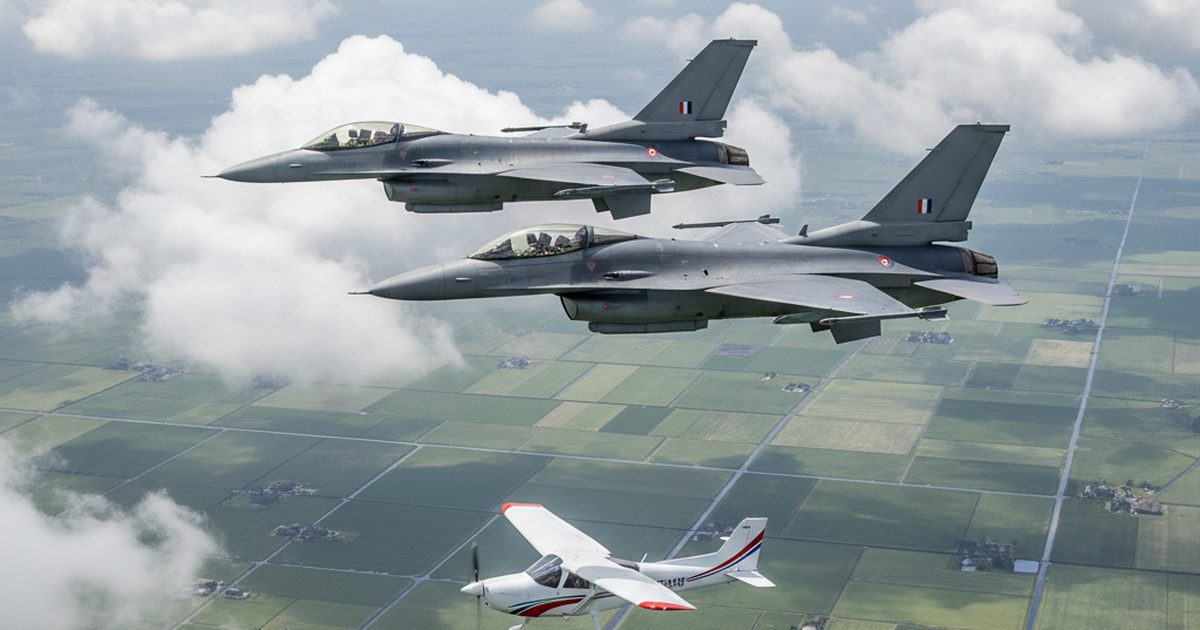
A Dutch Safety Board inquiry into a 2023 see-and-avoid airprox has reached a blunt conclusion. Visual lookout is a “weak” safety barrier when fast jets share airspace with light trainers. The encounter took place near Lelystad in November 2023. Two Royal Netherlands Air Force F-16s closed to within 240 m horizontally and 125 ft vertically of a training aircraft. They missed a mid-air collision only because the lead fighter pilot spotted the smaller aircraft on his transponder interrogator and broke away in time.
Consequently, investigators have asked the Dutch Ministry of Defence to reassess the operational risk. They also want better coordination between military air traffic centres. The doctrine of “see-and-avoid” has long underpinned separation between civil and military traffic in shared low-level airspace. However, the board says it cannot reliably keep 400-knot fighters apart from 90-knot trainers in Class E airspace.
The finding adds the Netherlands to a growing list of European authorities openly questioning unaided visual lookout in mixed-speed traffic.
What investigators concluded about the see-and-avoid airprox
The encounter happened on 16 November 2023. Two Lockheed Martin F-16s were returning to Volkel air base after an exercise. Meanwhile, a Tecnam P-Mentor had departed Lelystad airport on a commercial pilot training sortie that involved climbing and descending turns.
The F-16s were assigned 3,000 ft on a roughly southern heading. The Tecnam climbed to 3,000 ft and rolled out on a northern track. As a result, the two flights ended up “on more or less opposite courses at the same altitude.” That phrasing comes from the FlightGlobal report on the inquiry. The aircraft were more than 10 km apart at that point. Neither saw the other.
Inside Class E airspace, air traffic control does not separate instrument flights from visual flights. Furthermore, the F-16 formation and the Tecnam were working different military air traffic centre frequencies. Consequently, neither the controllers nor the pilots could hear each other’s radio transmissions.
An air traffic controller who had just come on duty called traffic about 2 nm ahead of the lead F-16. The fighter pilot picked up a return on his interrogator. Then he saw it on his radar. Finally, he acquired the small aircraft visually and took evasive action. Radar replay showed the F-16 — travelling at 420 kt — passed the Tecnam with 240 m of horizontal separation. Vertical separation was just 125 ft.
The Dutch Safety Board called the limitations of see-and-avoid in mixed-speed traffic a “recurring” observation. It noted that the Royal Netherlands Air and Space Force has since retired the F-16 in favour of the F-35. The newer fighter carries more capable sensors. Still, the board said a mid-air collision in similar circumstances “remains a realistic scenario.”
The technical setup: airspace, traffic mix, and speed
Lelystad sits inside the same lateral airspace block used by military fast jets recovering toward Volkel and other Dutch bases. The vertical structure is layered. Controlled airspace stacks above sectors of Class E and Class G where visual flight rules dominate.
Class E airspace is a hybrid. Instrument traffic is controlled and separated. Visual traffic is not. Under International Civil Aviation Organization (ICAO) standards, ATC issues traffic information to IFR aircraft about known VFR conflicts when workload permits. However, controllers do not have to keep them apart. The ultimate barrier is the pilot’s eyes.
The math is unforgiving. An F-16 at 420 kt and a Tecnam at 90 kt on reciprocal headings produce a closing speed of about 510 kt. That works out to roughly 9.4 nm per minute, or close to 870 ft per second. From first sighting to evasive action, the lead fighter pilot had a fraction of a second.
Human factors research used by the U.S. FAA in Advisory Circular 90-48E on pilots’ role in collision avoidance has long acknowledged a fundamental limit. Detection-to-evasion typically takes 12.5 seconds in benign conditions. That exceeds the time available in many high-closure-rate encounters. Additionally, a small head-on aircraft on a constant bearing presents almost no relative motion in the windscreen. The human eye preferentially detects motion.
The Tecnam P-Mentor, like most modern light trainers, is white over high-gloss surfaces. As a result, it is easy to lose against cumulus or low haze. The geometry of this airprox left almost no margin. Even with traffic information, a slow-moving trainer pilot would have had only a sliver of warning.
Why see-and-avoid keeps failing in mixed-speed traffic
The Dutch Safety Board’s language was unusually direct. “Pilots of slow-flying aircraft have minimal chances to detect a potential conflict and… make an evasive manoeuvre due to the high closing speed,” investigators wrote. By contrast, crews of high-speed military fighters “are in a better position to do so, due to their training, skills and on-board equipment.”
That is not a new observation. EASA, Eurocontrol and the U.S. National Transportation Safety Board (NTSB) have all flagged the same limits. Repeated airprox studies over the last two decades reach the same conclusion. Notably, SKYbrary’s standing entry on see-and-avoid summarises the consensus. The doctrine works best at low closing speeds, in good visibility, and with both crews aware of one another. Strip any of those conditions away and detection probabilities drop sharply. The pattern is not limited to military traffic, either: a recent near-collision between two airliners at São Paulo Congonhas showed surveillance and procedural barriers can fail in commercial airspace, too.
What makes the Lelystad case unusual is the combination of factors investigators stacked together:
- A 510-kt closure rate.
- Class E airspace where neither aircraft was being separated by ATC.
- Two military ATC frequencies that did not share traffic.
- A new controller picking up the situation late.
- A reciprocal-track geometry that minimised relative motion.
Any one of those failures might have been recoverable. Stacked, they reduced the safety margin to a transponder return on a fighter’s interrogator and a single pilot’s reaction time.
How other countries handle military and civil airspace overlap
The problem is not unique to the Netherlands. Densely used European airspace forces military fast-jet routes through busy vertical layers. Those layers are also used by general aviation, business jets and pilot training schools. Therefore, coordination is patchwork.
The United Kingdom uses a network of Military Low Flying System areas with published transit altitudes. Mandatory secondary-surveillance radar carriage backs the system in most controlled airspace. Britain has also extended a graduated transponder mandate for visual flight into increasingly large blocks of Class G. The UK Airprox Board catalogues every reported conflict. Similarly, it repeatedly cites see-and-avoid limits as a contributing factor in fast-jet/light-aircraft incidents.
Germany manages the issue through dedicated military training areas — the TRAs and TSAs. NOTAMs activate and deactivate these zones. Civil traffic stays out during use. The U.S. equivalents are Military Operations Areas (MOAs) and Restricted Areas. Civil VFR pilots receive warnings about MOAs, but they are not always kept out.
France has steadily extended ADS-B Out requirements down into general aviation. Likewise, EU-level rules are due to capture more light aircraft on a phased schedule. Australia ran a national review after the 2019 Mangalore mid-air collision. The review reached a similar conclusion. Visual lookout alone is no longer sufficient where speeds and traffic density are rising.
Each system trades airspace flexibility against safety margin. None has fully solved the problem the Dutch Safety Board is now describing.
What is likely to change after the F-16 airprox
The board’s recommendations point in two directions: airspace design and electronic conspicuity.
On airspace, it asked the Dutch Ministry of Defence to assess the operational risk of high-speed military aircraft operating near civil traffic and to “implement mitigation measures.” That language is broad. It could cover route changes, dedicated military corridors, additional restricted-area activation, or more aggressive use of temporary segregated areas during fast-jet recoveries.
On communications, the board called for improved coordination between military ATC frequencies. If two controllers handling traffic in adjacent sectors cannot share a real-time picture, controller-to-controller and crew-to-crew situational awareness collapses. That is exactly what happened at Lelystad.
Wider changes are likely to come from EU-level rulemaking. Specifically, EASA’s airspace and safety strategies have signalled stronger transponder and ADS-B Out mandates for VFR traffic. The push is sharpest where general aviation operates close to military or commercial routes. The European Commission’s Implementing Regulation on surveillance performance and interoperability (SPI) is already in force. Regulators expect to tighten it for light aircraft over the next several years.
The transition to the F-35, with its more capable sensors and data fusion, will help inside the cockpit. However, it does not solve the underlying airspace design problem. A 90-kt trainer and a 420-kt fighter still share the same uncontrolled altitude band. As long as that holds, the safety case rests on detection — and detection has limits.
What this means for safety practitioners
For military aviation organisations, the Lelystad finding is a reminder that operational risk assessments must account for the slower aircraft’s perspective. Fighter aircrew have helmets, training, sensors and threat-detection systems that bias their probability of detection upward. By contrast, a student pilot in a light trainer has none of those advantages.
For civil ATC and airspace planners, the case strengthens an old argument. Class E airspace next to active military routes needs more protection. Options include tighter surveillance, additional traffic information service, or selective uplift to Class D. Several European states are already trialling that approach.
For general aviation operators, the practical takeaway is straightforward. Carry the most capable transponder available. Fly with ADS-B Out where possible. Monitor the appropriate frequencies. Treat published military training routes as live hazards even when no NOTAM is active. None of those steps would have changed the Lelystad geometry on their own. In combination, however, they shift the odds.
The Dutch Safety Board did not say see-and-avoid should be abandoned. Instead, it flagged a narrower problem. The doctrine is a weak barrier when high-speed military traffic mixes with slow civil traffic in uncontrolled airspace. Other layers of defence are needed. That is a narrower claim than the headlines suggest, and a more durable one.
Mid-air collisions are rare partly because regulators and operators have spent decades layering controls on top of visual lookout. Ultimately, Lelystad is an argument for adding another layer — not for declaring victory because none of those layers failed all at once.
Sources
- FlightGlobal: “Dutch inquiry faults ‘weak’ see-and-avoid rules after F-16 airprox” (David Kaminski-Morrow, 1 May 2026).
- Dutch Safety Board (Onderzoeksraad voor Veiligheid): official site.
- SKYbrary: “See and Avoid” reference article.
- U.S. Federal Aviation Administration: Advisory Circular 90-48E, “Pilots’ Role in Collision Avoidance”.
Stay on top of incidents like this. Subscribe to FODNews for incident reports, prevention analysis, and sector news.