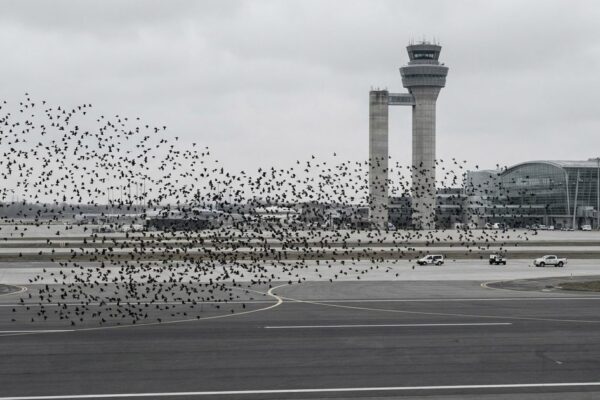

India Bird Strike Crisis: 1,782 Airport Incidents in 2025 — a 39% Year-Over-Year Jump
NEW DELHI — India recorded 1,782 bird strikes at airports in 2025, a 39% jump from the 1,278 logged in 2024 and more than double the 775 reported just four years earlier, the government disclosed to parliament last week.
The figures, shared by Minister of State for Civil Aviation Murlidhar Mohol in a written reply to the Lok Sabha, put the five-year cumulative total at 6,337 incidents — roughly three strikes every two days across the country’s civil aviation network.
The surge has renewed pressure on the Directorate General of Civil Aviation (DGCA), India’s aviation regulator, to move beyond a cycle of circulars and committee meetings that senior airport officials say has produced little change on the ground.
By the Numbers: A Decade-Long Climb
The year-on-year trajectory shows a near-unbroken rise since 2021.
- 2021: 775 incidents
- 2022: 1,131 incidents (+46%)
- 2023: 1,371 incidents (+21%)
- 2024: 1,278 incidents (−7%)
- 2025: 1,782 incidents (+39%)
The brief dip in 2024 offered little reassurance. The 2025 figure erased any progress and set a new peak, representing a 130% increase over the 2021 baseline.
Bird strikes are not unique to India. General aviation airports in the United States have seen a 14% surge in wildlife strikes in recent years, and Indonesia reported a spike in strikes during peak travel seasons. But India’s scale and acceleration stand apart.
The Hardest-Hit Airports
Delhi’s Indira Gandhi International Airport consistently leads the country in gross incident count, recording 442 strikes in 2022, 616 in 2023, and 419 in 2024. It remains the single most affected hub in the Indian network.
Mumbai’s Chhatrapati Shivaji Maharaj International Airport ranks second by cumulative volume, surrounded by dense urban habitat that limits traditional deterrence options.
Ahmedabad’s Sardar Vallabhbhai Patel International Airport tells a particularly sharp story. The airport logged 39 incidents in 2022, leaped to 81 in 2023, and reached 201 in 2024 — a more than fivefold increase in just two years. It is now among the highest-risk airports in the country by rate of growth.
Kolkata’s Netaji Subhash Chandra Bose International Airport also showed a rising trend, with 45 incidents in 2023 compared to 31 the previous year — the only major metro posting consistent year-on-year increases through that reporting window.
The Air India 171 crash at Ahmedabad brought the airport to international attention in 2025. The subsequent Aircraft Accident Investigation Bureau preliminary report identified a suspected fuel cutoff — not bird activity — as the trigger for the June 12 crash that killed 274 people. Even so, the inquiry focused renewed public and regulatory scrutiny on the airport’s persistent bird hazard environment.
Pilots and aviation experts had for years flagged Ahmedabad’s bird exposure. “The Ahmedabad airport has long been known for bird activity near the runway, which could have contributed to the incident,” multiple pilots said at the time, pointing to grass growth near runways during monsoon season attracting insects — and, in turn, birds.
Root Causes: What’s Drawing the Birds
India’s aviation regulatory framework is not silent on the issue. Rule 91 of the Aircraft Rules, 1937, prohibits garbage dumping and animal slaughter within 10 kilometers of an airport’s reference point, precisely because these activities draw scavenging and predatory birds into flight paths.
In practice, that prohibition is widely ignored.
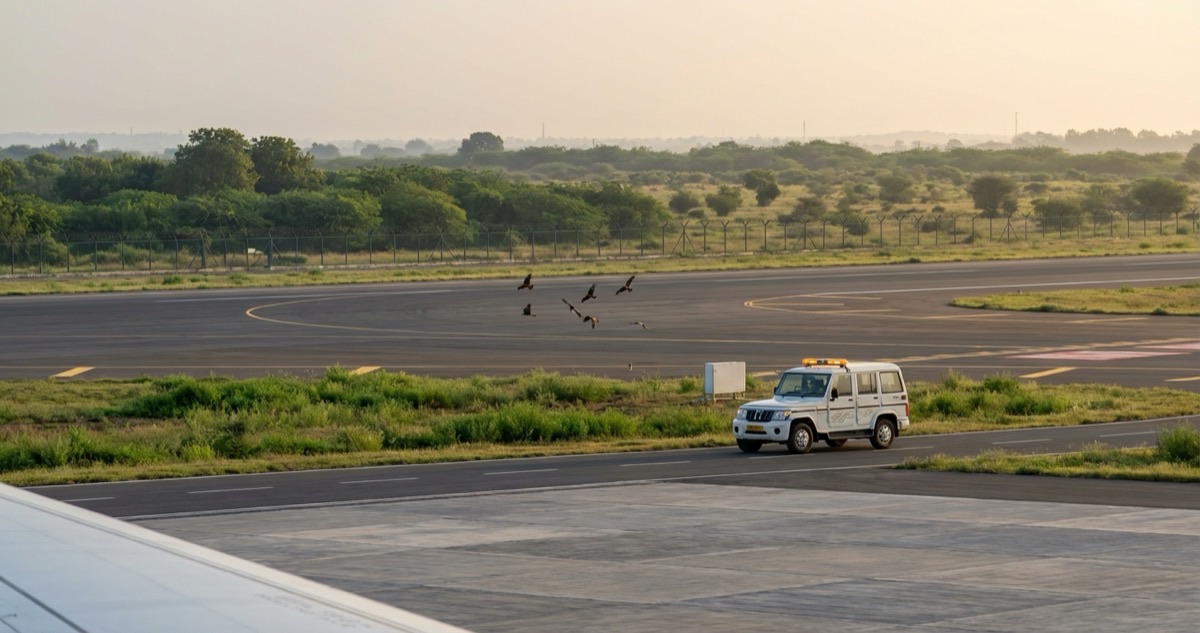
“Tell me which major airport in the country does not have garbage dumps and markets doing animal slaughter within 10 km,” a senior airport official told Down to Earth. “Unless the local administrations become serious, the bird menace will continue.”
A retired executive director of Air Traffic Control, Kalyan Choudhury, described the core enforcement gap: “We take multiple steps like cutting grasses, using bird catchers, and blasting fireworks to prevent bird incursion in take-off and landing zones. But we cannot do anything beyond airport areas.”
The problem compounds in high-density urban environments. Near several major airports, shops and informal markets have spread to the perimeter fence line. Open waste and animal byproduct disposal attract vultures, kites, and crows — species that pose the greatest ingestion risk to turbine engines during approach and departure.
Near Kolkata, a senior Airports Authority of India (AAI) official described the dynamic: “You will find that shops and markets have mushroomed close to most airports across the country, and waste is being dumped. This attracts birds that create problems for flights either taking off or landing.”
The ministry’s own analysis flags that strikes occur predominantly during takeoff and landing — the windows when aircraft are slowest, lowest, and most vulnerable to bird ingestion events.
Compliance on Paper, Not on the Ground
The DGCA has not been passive. Aerodrome Advisory Circular AD AC 06 of 2017 required aerodrome operators to implement an effective wildlife control mechanism. When compliance lagged, the regulator issued Aerodrome Advisory Circular AD AC 01 of 2022 — a second directive asking airports to identify gaps and ensure strict implementation of Wildlife Hazard Management Plans (WHMPs).
The repetition itself tells the story.
Airfield Environment Management Committees (AEMCs) are required at every licensed airport, bringing together airport authorities, local government bodies, and regulatory representatives to identify bird-attracting hazards and coordinate remediation. Senior officials describe a different reality.
“We hold these meetings for the sake of maintaining DGCA guidelines,” one official admitted. “But there has been hardly any implementation.”
A senior AAI official at Kolkata’s airport was more pointed: “While there should have been at least one kilometer of buffer zone after the dedicated airport area, neither has the government promulgated any specific norm nor does the local administration attach much importance to controlling birds in the vicinity.”
When local government bodies are questioned, responsibility bounces back. Municipal officials near one airport asked: “Do they conduct any awareness or facilitate action on ground apart from organizing meetings?”
The accountability gap sits at the intersection of two bureaucratic worlds — airport operators who control the airfield, and local administrations who control the surrounding land — with no effective mechanism to compel action from either side when the other defaults.
ICAO’s Annex 14 standards require aerodrome operators to assess wildlife hazard risks, report significant strikes, and implement mitigation. India’s WHMP framework is nominally aligned with those standards. The 2025 Asia-Pacific Wildlife Hazard Management Working Group emphasized performance metrics and regional data sharing as the next priority — tools that are only useful if ground-level enforcement catches up.
What Enforcement Would Require
Aviation safety specialists and airport officials consistently name the same set of interventions: closure of illegal slaughterhouses and garbage processing sites within the prohibited 10-kilometer radius; binding timelines for local administrations to act on AEMC recommendations; and independent audits of WHMP implementation rather than self-reported compliance.
Some airports have taken more aggressive steps. Mumbai’s Chhatrapati Shivaji Maharaj International Airport conducts monthly inspections up to 10 kilometers out, targeting dumps and slaughterhouses, supplemented by river cleaning and controlled tree trimming. The results have been partial — the scale of the surrounding urban habitat limits what perimeter management alone can achieve.
The FAA wildlife strike mitigation framework, built on decades of mandatory reporting and habitat modification data, illustrates what systematic enforcement infrastructure looks like over time. India’s reporting volume now dwarfs many international benchmarks — but the data’s value depends on whether it drives action.
What the data currently drives, at many airports, is another meeting.
The 2025 numbers — 1,782 incidents, a record, an acceleration, a 130% rise over five years — make the stakes of that inertia hard to ignore. Engine damage events from bird ingestion can be survivable, but they are expensive and expose the structural weakness of a system where the rules exist and the enforcement does not.
Whether India’s DGCA, airport operators, and state governments can translate the next circular into measurable outcomes will determine whether 2026 sets another record — or begins to reverse a five-year climb.
Subscribe to FODNews for ongoing coverage of wildlife hazard management and aviation safety.
Sources
- Economic Times — “Bird-hit incidents reported at airports rose to 1,782 in 2025: Govt” (2025)
- Down to Earth — “Implementation of environment and wildlife norms around Indian airports remains on paper”
- DGCA, Government of India — Directorate General of Civil Aviation
- ICAO — Annex 14, Volume I — Aerodrome Design and Operations (Wildlife Hazard Management provisions)
- ICAO Asia-Pacific — Wildlife Hazard Management Working Group, Final Report AP-WHM WG/7 (2025)
- Lok Sabha — Written reply by Minister of State for Civil Aviation Murlidhar Mohol, Unstarred Question No. 2267 (2026)
- NDTV — “Bird-hit incidents reported at airports rose to 1,782 in 2025: Centre”