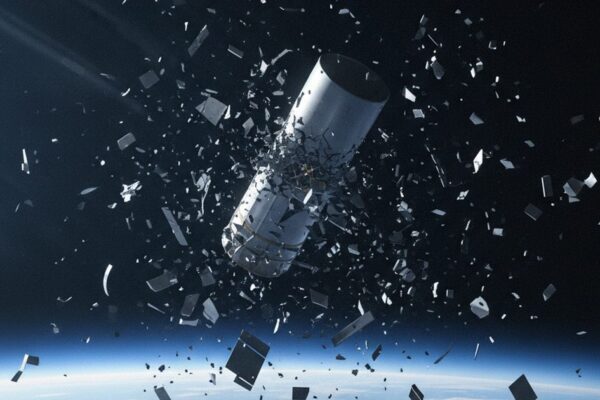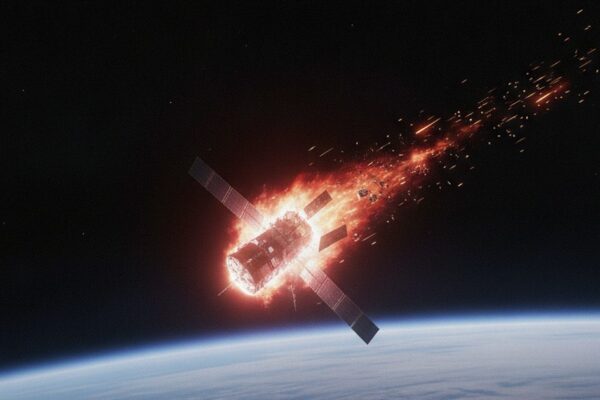
For decades, the solar activity–orbital decay relationship was understood as a linear gradient — the more active the Sun, the faster space debris falls. New peer-reviewed research published in Frontiers in Astronomy and Space Sciences complicates that picture in an operationally significant way: the relationship is not smooth. There is a threshold, and crossing it can nearly double the rate of descent.
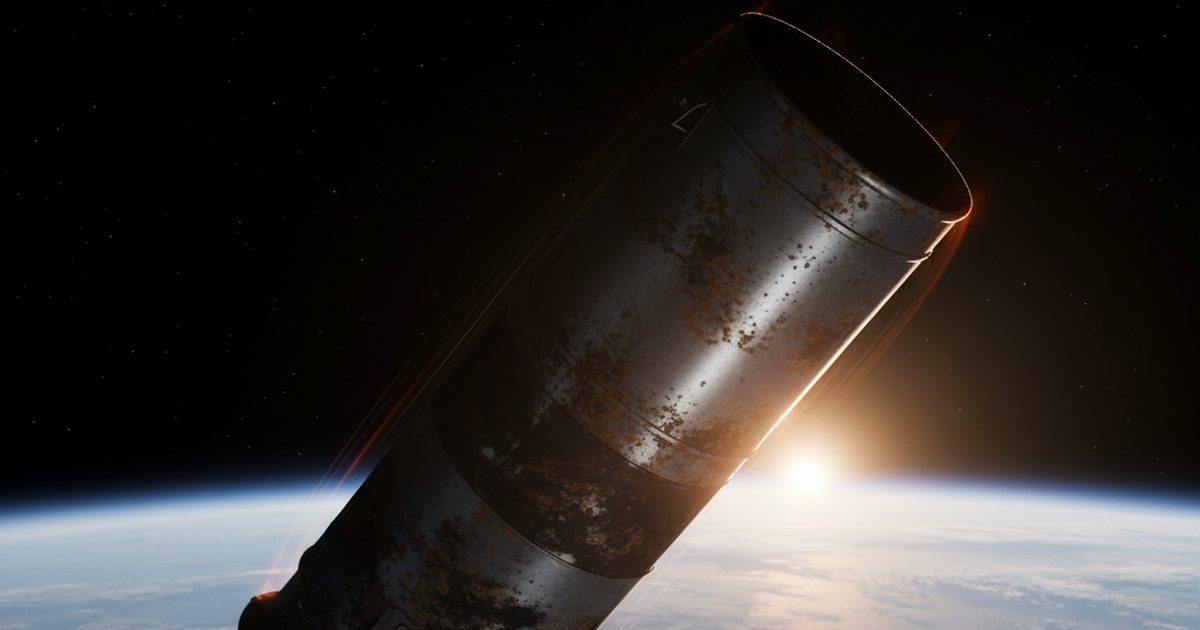
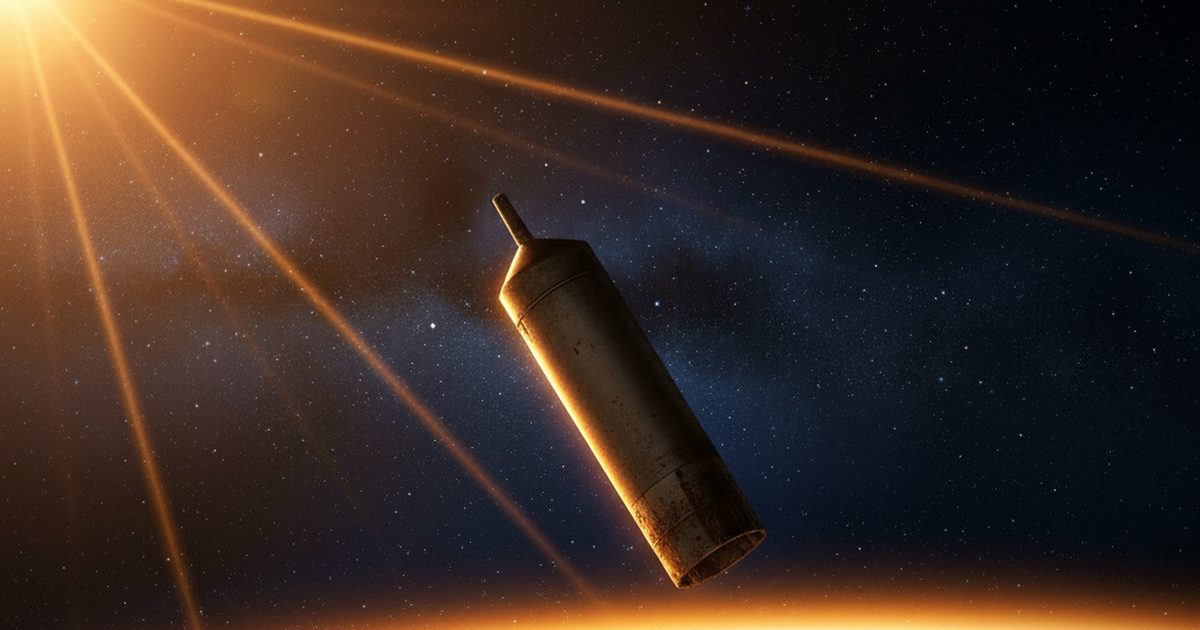
The finding comes from a 36-year dataset built around 17 pieces of Cold War-era rocket debris that have been drifting in low Earth orbit since the 1960s — objects that, precisely because they have never fired a thruster, provide a clean atmospheric signal untouched by human intervention.
The Long Game: 17 Objects, Three Solar Cycles
The study was led by Ayisha M. Ashruf of the Space Physics Laboratory at India’s Vikram Sarabhai Space Centre in Thiruvananthapuram, alongside co-authors Ankush Bhaskar, C. Vineeth, and Tarun Kumar Pant. The team drew on Two-Line Element (TLE) data from the Space-Track orbital surveillance database — the standard catalog maintained by the U.S. Space Force’s 18th Space Control Squadron — to reconstruct the altitude histories of 17 objects across three complete solar cycles from 1986 to 2024.
The objects themselves read like a Cold War almanac: TIROS weather satellites, Thor rocket bodies, Delta stage fragments, and two Soviet-era Cosmos objects. They range in mass from under 20 kilograms to more than 1,400 kilograms, orbit at inclinations between roughly 48 and 99 degrees, and circled Earth every 90 to 120 minutes at altitudes between approximately 600 and 800 kilometers throughout the study period.
The selection criteria were deliberately narrow. The research team began with 95 candidate objects from the 1960s and filtered aggressively, retaining only those with stable near-circular orbits, continuous tracking data across the full 36-year window, and no maneuvering capability. Seventeen survived. Their passivity is the point: with no thruster ever fired, every meter of altitude lost is unambiguously attributable to atmospheric drag — whose density fluctuates with the Sun’s approximately 11-year activity cycle. That makes Cold War-era hardware uniquely valuable as a scientific instrument: six decades of uninterrupted, unmodified orbital records.
The 67 Percent Threshold
Solar activity drives thermospheric density. As the Sun approaches its activity peak, extreme ultraviolet (EUV) radiation heats and expands the thermosphere — Earth’s upper atmospheric layer between 100 and 1,000 kilometers altitude. That increased air density at orbital altitudes produces greater aerodynamic drag on any passing object, gradually lowering orbits over time.
Earlier research had documented this general relationship. What it had not resolved was whether the connection was linear throughout a solar cycle, or whether there was a specific inflection point. The Ashruf team set out to answer that question by fitting Gaussian curves to the sunspot record for each of the three cycles studied, then identifying where the decay behavior of the 17 tracked objects shifted.
The result was consistent and striking: a transition between approximately 67 and 75 percent of each cycle’s peak sunspot number. Below that threshold, orbital descent was slow and gradual. Above it, the curve steepened sharply. The pattern held across all three solar cycles and across the entire range of 17 independent objects — different masses, different inclinations, different altitudes, same transition window.
“The threshold doesn’t seem to be tied to a fixed value of solar radiation, but rather to how close the Sun is to its peak activity,” Ashruf noted in the paper. The finding was corroborated by direct EUV measurements from the Solar and Heliospheric Observatory (SOHO): within the rapid-decay windows the debris data identified, EUV flux in the 0.1 to 50 nanometer band ran roughly 50 to 130 percent above levels recorded outside those windows. The debris records and the solar physics pointed to the same mechanism.
The statistical picture was unambiguous. The F10.7 radio flux index — a standard solar activity proxy — accounted for approximately 75 percent of the variance in decay rates across the 17 objects. Sunspot numbers explained around 67 percent. Geomagnetic indices fared poorly by comparison: the AE index, which tracks disturbances linked to particle precipitation, explained less than 2 percent of long-term decay variance. The Dst index, measuring the ring current associated with magnetic storms, accounted for roughly 22 percent.
The implication for debris modeling is significant: sustained long-term decay is driven overwhelmingly by solar EUV forcing of the thermosphere, not geomagnetic storms. Debris-environment models that weight geomagnetic indices heavily in long-range reentry predictions may be using the wrong input.
Solar Activity and Orbital Decay: Three Cycles, Starkly Different Rates
The three solar cycles in the dataset were not equivalent in strength, and the debris records reflected that directly.
Solar Cycle 22, which peaked around 1989 to 1991, was the most active of the three. During that maximum, the 17 tracked objects descended at a mean peak rate of 0.59 meters per hour. Solar Cycle 23, moderately active with a peak around 2000 to 2002, produced a mean rate of 0.54 meters per hour. Solar Cycle 24 — historically weak, with its maximum around 2014 — came in at just 0.25 meters per hour, roughly half of Cycle 22’s pace.
The pattern is clear: each successive cycle, as solar activity weakened, produced proportionally less orbital decay. Because Cycle 24 was anomalously quiet, any operator or debris model calibrated against recent historical data is likely working from a baseline that understates what a more typical solar maximum produces.
Solar Cycle 25 peaked in late 2024. NOAA Solar Cycle 25 tracking shows the current cycle performing more strongly than Cycle 24 and broadly comparable in intensity to Cycle 23. Using the study’s threshold framework, the 67 percent crossover point has already been passed — meaning the accelerated-decay window is not a future risk to plan against. It is the current operating condition.
As FODNews previously reported in coverage of the NASA Van Allen Probe A reentry, the present solar maximum has already influenced object reentry timelines in ways that caught operators off-guard. The Ashruf study provides the first quantitative framework for understanding when, within a solar cycle, those surprises are most likely to concentrate.
What the Threshold Means for Operators
The practical value of a threshold is precision. Rather than tracking the entire solar cycle diffusely, satellite operators now have a more specific indicator: when sunspot counts cross roughly two-thirds of the expected cycle peak, the drag environment enters a qualitatively different regime.
The study notes that missions launched near solar maximum may exhaust propellant reserves faster than planning tools predict, particularly when those tools use average solar conditions rather than cycle-phase-specific drag rates. The difference between quiet-Sun drag and peak-Sun drag in an active cycle spans roughly 2.4-to-1 — not a rounding error, but a mission-life variable.
The February 2022 Starlink incident showed what such underestimation can cost: a moderate geomagnetic storm shortly after launch raised atmospheric drag enough to deorbit 38 satellites before they reached operational altitude. The mechanism was an acute storm rather than sustained solar maximum, but the vulnerability is the same — planning tools calibrated to baseline conditions badly underestimate drag when the thermosphere runs above its historical norm.
The threshold finding also matters for conjunction analysis. As unmaneuvered debris objects accelerate through their solar-maximum descent, their predicted orbital trajectories shift over compressed timescales. Close-approach calculations relying on decay rates from quieter solar conditions may generate false confidence about separation distances. This concern is particularly acute for operators maintaining constellations in the 600 to 800 kilometer band, where the study’s 17 objects spent their entire tracked lifetime.
The broader LEO crowding context amplifies that concern. As FODNews noted in coverage of the ESA Space Environment Report 2026, the object count in low Earth orbit continues to grow faster than natural removal mechanisms can reduce it. Solar-driven reentry is one of the few passive debris-clearing forces that operates at scale — but it introduces its own conjunction risks, in the form of uncontrolled reentry corridors whose timing and trajectory become harder to predict when models rely on the wrong solar activity driver.
Open Questions and Limitations
The Ashruf study is explicit about its boundaries, and they are meaningful ones for the current commercial space environment.
The 17 objects all orbit between roughly 600 and 800 kilometers altitude. The paper makes no claim that the same threshold applies below 600 kilometers, where atmospheric density is higher and the solar-drag relationship may behave differently. Most large commercial constellations now in service operate well below that floor. Extending the threshold framework to the 300 to 550 kilometer regime requires separate analysis.
The study also encountered a persistent polar anomaly. Two objects — SAT 733, a Thor Agena D rocket body, and SAT 734, designated OPS 3367A — both in near-polar orbits at approximately 99 degrees inclination, showed large discrepancies between modeled and observed decay that no scaling factor could close. The paper interprets this as evidence that the NRLMSIS 2.0 atmospheric density model underestimates variability at high latitudes, where geomagnetic activity influences the thermosphere through mechanisms not well captured by lower-latitude empirical data. For operators in polar or sun-synchronous orbits, reentry predictions may carry larger uncertainties than current models reflect.
The three solar cycles studied were also moderate by historical standards. The strongest cycles on record — including Cycle 19 in the late 1950s, which produced a sunspot maximum roughly twice as intense as Cycle 22 — fall outside the dataset. Whether the 67 to 75 percent threshold holds under extreme conditions, or shifts, is a question this data cannot answer.
The paper, published open-access in Frontiers in Astronomy and Space Sciences, represents 36 years of passive observation converted into an operational planning framework. The Cold War hardware it relied upon — objects no agency placed in orbit for this purpose — turns out to have been recording something operationally relevant all along.
Subscribe to FODNews for continued coverage of space debris research and the evolving LEO environment.
Sources
- Ashruf, A. M., Bhaskar, A., Vineeth, C., & Pant, T. K. (2026). “Characterizing Solar Cycle Influence on Long-Term Orbital Deterioration of Low-Earth Orbiting Space Debris.” Frontiers in Astronomy and Space Sciences, 13. DOI: 10.3389/fspas.2026.1797886
- Trekzone Media. (2026, June 3). “Solar Activity Drives Space Debris Orbital Decay, 36-Year Study Finds.”
- SpaceDaily. (2026, June). “Rocket Debris That Has Been Drifting in Low Earth Orbit Since the 1960s Just Helped Scientists Find Something They Had Missed for Decades.”
- U.S. Space Force / 18th Space Control Squadron. Space-Track.org Two-Line Element Orbital Data Repository.